 |
khanjar.ai |
Oman AI Implementation

- AI Assisted Call Transcription Analytics
- OCR (Optical Character Recognition) of Digitized Documents Images
- Data Base Development & AI Assisted Analytics Using SQL
- AI Data Base Analytics of Worker and Corporation Safety Compliance
- AI Data Base Analytics of Omani Traffic to Optimize Transport Flow
- AI Assisted Optimization of Permitting Processes for Urban & Rural areas
- AI and Expanding Tourism in Oman
AI Assisted Call Transcription Analytics

AI transcription is the process of using AI technology to convert audio and video content into text. Unlike manual transcription, where a person listens and types out what they hear, AI transcription tools do this automatically. These tools use natural language processing, machine learning algorithms, and vast databases of linguistic data to recognize and transcribe speech.
AI transcription is increasingly used in call centers to document conversations, it ensures regulatory compliance, and serves as a reference for training or quality assurance purposes. Unlike manual transcription, it is faster, more cost-effective and can be scaled to handle a large volume of calls simultaneously.
Features & Benefits for Oman:
Government agencies implementing AI Call Transcription can improve internal workflow efficiencies. More importantly, intra-operability among various agencies can be established as AI transcripted databases can be queried both within and among various governmental agencies and departments.
OCR (Optical Character Recognition) of Digitized Documents & Images
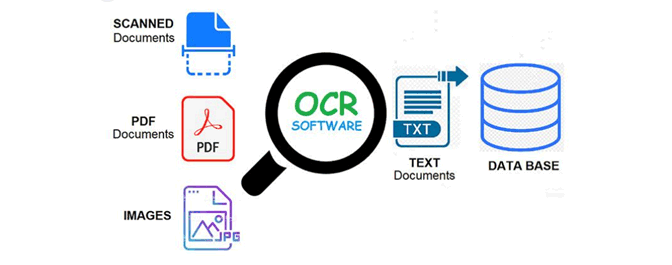
OCR software helps recognize and convert images of printed or handwritten text into editable and searchable digital text. Old archival documents from earlier decades can also then be queried for information and data retrieval. It is an essential tool in the processes of automation, document processing, and digitization

OCR tools are usually integrated with machine learning and pattern recognition algorithms.

Features & Benefits for Oman:
Historical printed documents and images can be brought into the digital era. Current printed materials can also be fully digitized and queried using AI.
Data Base Development & AI Assisted Analytics Using SQL

Organizations now have to manage more complex portfolios that include cloud and on-premise databases. Modern web services and mobile apps use data, making database development a critically important. Government agencies today collect and rely on massive data to make strategic decisions and improve product and service offerings.
What is AI in Data Analytics? It is the application of artificial intelligence (AI) to analyze large sets of data. This allows data analysts ti=o identify trends and gain insight into the behavior of consumers, public users of government services, or other datasets.
AI can process and analyze massive datasets in real-time, allowing data analytics to overcome traditional limitations. From predictive analytics to anomaly detection, AI algorithms can uncover patterns that human analysts might miss. This allows government planners to make proactive and data-driven decisions.
The first stage of a good database development process is understanding the organization’s requirements. There are several different types of databases, and they serve different purposes.
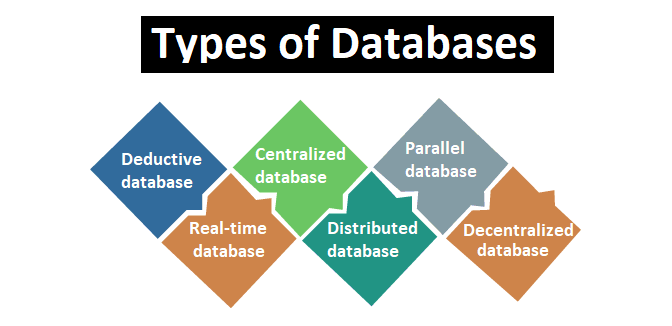
Latest software and technological trends such as Oracle, MySQL database, Teradata, SQL Server, IBM DB2, Sybase, Netezza, PostgreSQL, and much more are used to convert, process, and store data into large databases.

Databases can store very large numbers of records efficiently (they take up very little space). It is very quick and easy to find information. It is easy to add new data and to edit or delete old data.
Data can be searched easily as it ensures clarity in your big data storage for carrying out smooth business operations.
The role of AI is to fully optimize searches and queries of the data base. Moreover, AI can optimize the initial modeling of what kind of a data base needs to be established and to custom configure its architecture.
Features & Benefits for Oman:
Simplicity
Integrating AI into analytics streamlines the process of finding relationships between data, and allows for large meta data interconnectivity allowing for better search results.
Productivity
For analytics consumers, AI speeds up queries and studies of large datasets without the need for expertise or user intervention. AI also can help configure data base architecture for optimal end user utilization.
Enhanced user experience
AI improves customer interactions. It facilitates predictive analytics
AI Data Base Analytics of Worker and Corporation Safety Compliance

All employers want to ensure their workplaces are safe zones that are free from accidents. Nevertheless, work-related incidents and health concerns persist. And must be reported and officially recorded. Often public safety is at stake, and it is the role of government agencies to help address workplace hazards, and ensure safety for its citizens.

With AI analytics of work related incidents and regulation violations, the Omani Government can help companies to improve hazard detection, lower risk, and create safer overall working conditions. This is important particularly in sectors employing contract or temporary workers like construction.
Oman’s construction industry will expand by 3.3% in 2024, supported by a rising foreign investment, coupled with the government’s continued focus on infrastructure development and investments in renewable energy sector in line with its objective to attain carbon neutrality by 2050.

Source: Yahoo Finance; https://finance.yahoo.com/news/oman-construction-industry-report-2023-170500488.html
Features & Benefits for Oman:
Strong Construction growth will occur in Oman for 2024-2030 and beyond. Safety supervision, and the challenges of monitoring an expanded construction workforce will benefit from AI analytics.
AI Data Base Analytics of Omani Traffic to Optimize Transport Flow

Digital technologies can revolutionize urban management by addressing traffic congestion challenges. For example, sensors placed on roads can collect traffic volume, speed, and congestion data.

The data can help predict traffic patterns and optimize traffic management in real-time. Traffic congestion affects the environment, economy, and quality of life. AI can be used to optimize traffic flow, transport goods more efficiently, and reduce the transportation related carbon foot print and therefore help the environment.

Predictive AI Analytics use machine learning algorithms, AI can analyze traffic patterns and predict traffic flow in real-time. This allows traffic management systems to anticipate congestion before it occurs and take proactive measures to reduce it. This predictive capability helps optimize traffic signal timings, reduce waiting times at intersections, and improve overall traffic flow.
Connectivity assisted by AI can also provide data about parking availability, allowing drivers to quickly find parking spaces and reduce the time spent circling for a spot.
Features & Benefits for Oman:
AI Analytics can address the help optimize transportation growth, while helping to reduce Oman’s carbon footprint and promote a cleaner environment.
AI Assisted Optimization of Permitting Processes for Urban & Rural areas

One example of AI in urban planning is using machine learning algorithms to analyze data on traffic patterns, population density, and land use. This information can then be used to make informed decisions about where new infrastructure should be built or how existing infrastructure should be improved.

Traditional methods of analysis, including statistics, and literature review, are no longer sufficient to analyze all the data and reports available. AI, specifically language models such as ChatGPT developed by OpenAI, machine learning, and deep learning models, offer improved opportunities for urban planners to extract and analyze information and to develop better plans.
Features & Benefits for Oman:
Similar to the role of AI in managing traffic growth. AI will help reduce Oman’s carbon footprint and promote a cleaner environment. Under Royal Decree No. 28/2019, Oman committed to the Paris Agreement on 24th January 2019. Additionally, Oman set an ambitious trajectory to achieve carbon neutrality by 2050 as of November 2022.
AI and Expanding Tourism in Oman

Artificial Intelligence (AI) and Machine Learning (ML) can revolutionize tourism practices. A listing needs to offer more than just an available space; it needs to convey a compelling story about the resort property and its surrounding locale to prospective guests. AI can provide automated responses to frequently asked guest questions.

In addition, Generative AI, a subset of AI that uses machine learning models to create content similar to human-generated content, can optimize writing an appealing resort property reports reflecting real time as they happen seasonal events and cultural activities.

Personalization Generative AI can tailor the language and style of the listing based on the target audience’s preferences, whether they are families, business travelers, or adventure seekers. This level of personalization can increase engagement and tourism rates. The end goal of this is to increase tourism in Oman, and to highlight the country’s many attractions.
Features & Benefits for Oman:
The contribution of the tourism sector to the gross domestic product was 2.4 % in 2021. Oman seeks to increase it to 5% by 2030, and 10% by 2040. The goal is to increase the number of visitors to 11.7 million by 2040. AI can help promote tourism and maximize the impact of every Omani Rial spent.

Final Summary Statement
AI – Changing the game.
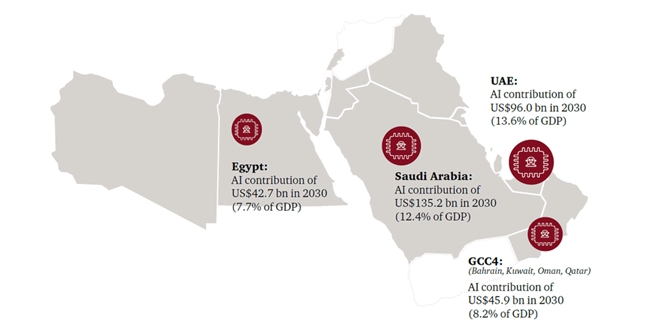
Artificial Intelligence (AI) is going to be a big game changer in the global economy, and much of the value potential is up for grabs. Governments and businesses across the Middle East are beginning to realize the shift globally towards AI and advanced technologies.
The Middle East Region is faced with a choice between being a part of the technological disruption, or being left behind. Given the economic impact for the region, being left behind is not an option.
AI is being implemented in other neighboring GCC Countries.
The AI-powered virtual assistant deployed by the Dubai Electricity and Water Authority has responded to over 6.8 million queries since its launch in 2017. Such virtual assistants improve customer service efficiency and provide quick responses to inquiries.
Qatar’s Ministry of Labour used it to build a model for all government entities that would allow them access to labor-market insights to help make informed decisions on sustainable development.
What are the next steps?
First, we suggest that an Initial Pilot Proposal ( IPP) to be approved which would be completed in 60 days. The proposal would seek additional detailed input from Omani Ministry Officials. Specific recommendations would then be presented.
Secondly we suggest the development of a SWOT Chart to help Omani Officials understand their position relative to other regional governments.

Third and finally we suggest developing an ordered Hierarchy of Program Initiatives based on different criteria.
The IPP would outline:
- Programs that are the most important regardless of cost or difficulty.
- Programs that can be done very quickly and affordably (low hanging fruit).
- Programs arranged in levels of difficulty for implementation.
No one company or organization can completely fulfill the AI planning, development, and implementation of AI for all of Oman. It will require a multi team effort possibly from many countries and consulting groups. The IPP is a logical first step which takes into account the latest 2024 resources in AI, and develops a work road map for moving forward.